


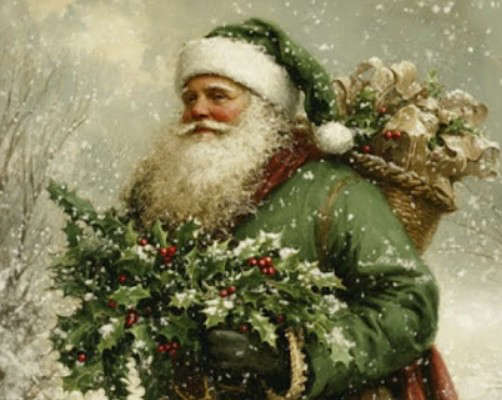
When people picture Father Christmas, most see a jolly, bearded man in a red suit trimmed with white fur. But that iconic outfit has a more complex origin than many realise, and for centuries, he wore green.
The modern image of Father Christmas has been shaped over hundreds of years through a blend of folklore, religion and cultural reinvention. In Britain, the original figure wore a long green hooded cloak, often with a wreath of holly, ivy or mistletoe. He symbolised the return of spring and warmth during the darkest part of the year.
In the fifth and sixth centuries, he was known as King Winter or Father Time. People would dress up as him and invite him into their homes, believing it might bring luck or a mild winter. When the Vikings arrived, they brought their own traditions. Odin, the Norse god, would ride across the sky during Yule, dressed in a long cloak and delivering rewards or punishments. His image, white beard, magical travel, helped shape what came next.
Meanwhile, Saint Nicholas, the 4th-century Bishop of Myra in modern-day Turkey, became known for secret acts of kindness, often to children. Stories of him dropping coins down chimneys laid the groundwork for what we now consider Christmas traditions. He wore bishop’s robes, red and white in colour, which some historians believe directly influenced Santa’s eventual look.
By the 19th century, various traditions from across Europe and the UK had merged. In England, Father Christmas had come to represent generosity and festive spirit. Across the Atlantic, Dutch settlers brought Sinterklaas to America, where he slowly became Santa Claus.
In 1863, illustrator Thomas Nast began drawing Santa for Harper’s Weekly. His engravings introduced key features such as the red suit, toy workshop and letter writing. This version of Santa was already familiar before Coca-Cola ever entered the picture.
Coca-Cola’s role came in the 1930s, when the company hired artist Haddon Sundblom to produce festive advertising images. His joyful, plump Santa wore a red coat with white fur and a wide black belt. These drawings were used for more than 30 years and helped standardise the image around the world.
Despite the myths, Coca-Cola did not invent Santa’s outfit. They built on an image that already existed and helped cement it through mass advertising. But the red and white suit has deeper roots in religious dress, folklore and art.
Even now, in places like Dalby Forest, Father Christmas sometimes appears in his traditional green. A reminder that long before corporate colours, he was a figure of winter warmth, kindness and renewal.
 Bartender has alcohol license revoked due to drink driving
 Radcliffe child sex offender jailed for life after abusing five children
 Conservatives select Emma Lee as candidate for Tottington by election
 Bowlee car boot sale returns for the 2026 season
 Inside the major refurbishment transforming Tenpin Rochdale
 Former Middleton pub could reopen as convenience store after closure
 Councillors raise concern over Riverside Housing sale of social homes in Middleton
 Heywood community raises £1799.65 as Donna Dolan shaves hair for Macmillan
 Road closure in Ramsbottom
 Rochdale families urged to shape national consultation on keeping children safe online
 Civil war erupts as Labour activists in Gorton and Denton say party is ‘not willing to change’
 Silver Street offices approved as temporary housing





Comments
Add a comment