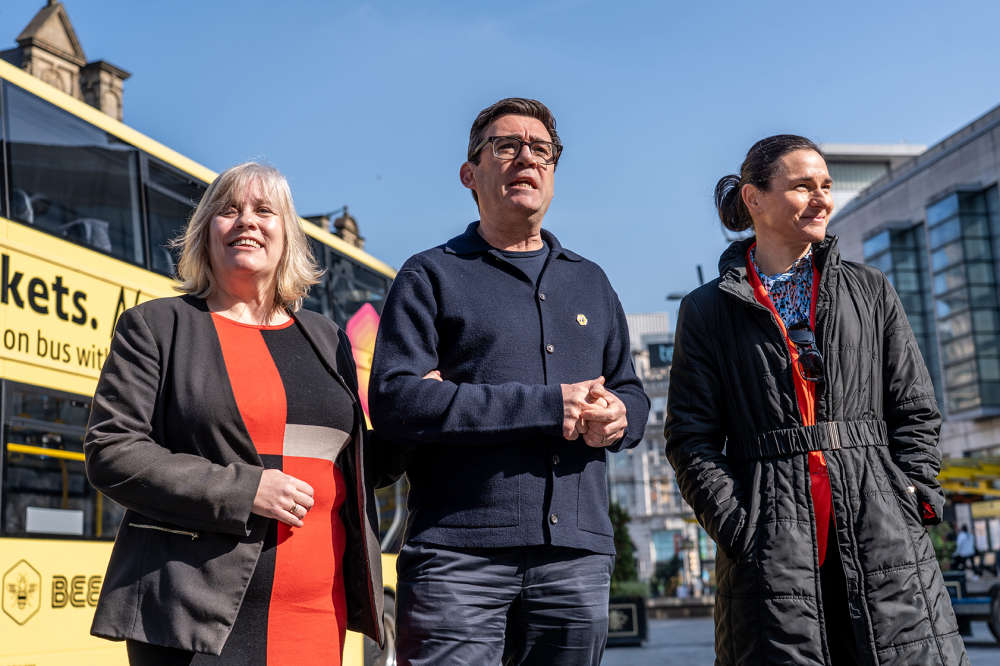
Andy Burnham’s stint as Greater Manchester mayor could be drawing to a close after he announced his intention to return to Parliament.
Andy Burnham’s stint as Greater Manchester mayor could be drawing to a close after he announced his intention to return to Parliament.
Fighting the Gorton and Denton by-election would mean Burnham needs to resign as mayor because the law says mayors which have police and crime commissioner powers, as he does, cannot be MPs simultaneously.
It would bring to an end a nearly-nine-year shift as Greater Manchester’s inaugural mayor in which Burnham sought to revolutionise the city’s housing, transport, and emergency services. During that period, his popularity has soared and the city looks very different to how it did in May 2017.
It’s certainly been memorable, which is why we’ve picked out Burnham’s five greatest moments in the spotlight.
Response to the Manchester Arena bombing, May 2017
Greater Manchester entered a bold new world when Andy Burnham was elected as the city’s first metropolitan mayor on May 4, 2017. It wasn’t known if he’d be a political white elephant, or become a figurehead for the city.
Exactly two weeks into his term, Greater Manchester had its answer when a terrorist detonated a bomb at Manchester Arena, killing 22 people. Although it was early days, he encouraged Mancs to carry on as normal the morning after the tragedy.
“I want to thank the people of Manchester,” he said. “Even in the minutes after the attack, they opened their doors to strangers and drove them away from danger.
“They gave the best possible immediate response to those who seek to divide us. And it will be that spirit of Manchester that will prevail and hold us together.”
Within days, a city struck dumb with grief showed an outpouring of love. Flowers filled every corner of St Anne’s Square, just as beautifully moving impromptu choruses of Oasis’ ‘Don’t Look Back In Anger’ filled the streets.
Confronted by an ‘evil act’, Manchester chose love. Burnham cannot take all the credit for that, of course, but he immediately set the tone that this city, this great city, would not descend into hate.
After the flowers were moved from St Anne’s Square, it became apparent the mayor had a job on his hands in turning both GMP and the fire service around, after their responses were roundly criticised in the subsequent bombing inquiry.
Eventually, he told chief constable Ian Hopkins to stand down and replaced him with Stephen Watson in 2021, when the force was in special measures. Dave Russel was named chief fire officer in September 2020. The moves worked, as both are now rated largely good or adequate by inspectors.
Covid-19 ‘tier 3’ press conference, October 2020
Covid-19 devastated Greater Manchester, with the city’s historic deprivation and poor health making it easier for the virus to spread.
But Greater Manchester was also hit hard by government restrictions. In summer 2020, ministers effectively put the city into lockdown with a night’s notice. By autumn, a new system was in place, with the strictest measures called ‘tier 3’.
By October 20, 2020, leaders had continually argued Greater Manchester needed £65m more financial support from the government with tighter restrictions, something Downing Street resisted.
That day, they called a press conference to make the point again. But the government had had enough, tier 3 was ordered without any more than the standard £20m support package during the media event.
The image of ex-Manchester council leader Richard Leese showing Burnham his phone with the news, followed by the mayor puffing his cheeks and decrying it as ‘brutal’ is an image etched in the public’s consciousness.
The government backed down a day later, offering £60m. But the narrative had been set: Greater Manchester was being hard done by, and Burnham was there to fight. His ‘King of the North’ moniker soon followed.
Implementing Bee Network buses, January 2025
While Burnham’s first term was dominated by sorting out the emergency services and Covid-19, his second stint focused on transport.
His vision had long been to take buses back into public control. In 2021, he announced plans to do just that with the Bee Network.
After years of legal arguments with bus firms, the first Bee Network bus ran on September 24, 2023. By the following March, half of services were under Transport for Greater Manchester’s control.
The project was completed on January 5, 2025, at a snow-covered Wythenshawe bus station.
“This is a big moment for us. It’s a journey the city-region has been on as long as I’ve been around,” the mayor said. “It’s a huge achievement for us all. I think it’s the biggest change to buses this country has seen in a long, long time.”
He wasn’t wrong: He’d done something which hadn’t happened outside London since 1986 that morning.
Innovations like tap-and-go, simpler fares, and combined tram and bus tickets followed. At the end of 2025, the mayor confirmed Bee Network trains will start service in late 2026, with eight commuter lines under public control by 2028.
The Good Growth Fund and ‘Manchesterism’, November 2025
Manchester’s skyline has changed dramatically during Burnham’s time as mayor. He cannot claim credit for all of this, given Manchester council’s long-standing developer friendly approach encouraged upwards growth since the late 1990s.
However, the ‘housing investment loans fund’ (HILF) was administered by his office, which gave developers the cash needed to build homes and towers. Although controversial, every penny of the £300m fund was repaid, and ‘recycled’ four times over, so £1.2b was loaned out, and the interest paid for other affordable housing.
It was such a success the government decided to extend the HILF beyond its 10-year lifespan. However, working with a new chief executive, Burnham decided to incorporate the £300m into a much bigger £1b ‘Good Growth Fund’ in November 2025, with extra money coming from the Pension Fund and borrowing.
He said it ‘marked a decisive break with trickle-down economics and old extractive approaches to growth’. The fund has already given millions to 30 projects across the city, with more expected to be announced in March.
Hot on its heels, he unveiled a ‘Manchesterism’ plan to ‘reindustrialise the birthplace of the industrial revolution’ with five growth clusters earlier this week, again putting economic growth at the top of his agenda.
Getting the railways back on track, January 2026
The north’s railways are unreliable and slow, something successive governments and councils have tried to address since 2009 with the first iteration of HS2.
It’s a battle Burnham has picked up, first backing Northern Powerhouse Rail across the M62 corridor, then fighting in vain to keep the HS2 connection to Manchester. After years of false starts and new plans, he finally convinced the government to invest heavily earlier this month, when the new Liverpool-Manchester railway line was confirmed.
Crucially, Burnham, along with other leaders, made an 11th-hour stand against ministers’ plans to bring the new line into Manchester on ugly railway viaducts. They secured a review, set to report back in the summer, over how feasible it is to build an underground Piccadilly railway station.
Should it go ahead, it paves the way for three underground Metrolink tunnels and huge development in the city centre.
 What is really happening at the former soap star’s home in Heywood
 Green Party selects Tottington resident Chloe King as candidate for Bury by election
 Bury pub The Blue Bell unveils £400,000 refurbishment with new fireplaces and expanded space
 New McDonald’s drive-thru refused on health grounds
 Rochdale home buyers invited to explore new homes at Silver Hill Manor event
 Charity in Bury appeals for help after Henry Hoover stolen from community project
 Candidates confirmed for Tottington by election
 Reform UK selects George Martin as candidate for Tottington by election
 Prestwich Prep to close down
 New padel club approved for Rochdale
 Schools across the borough celebrate World Book Day with costumes and reading events
 Police appeal for witnesses after 19 year old shot in Rochdale street



Comments
Add a comment