

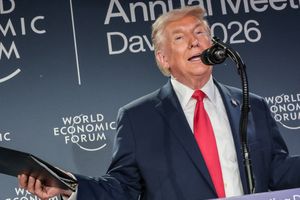
Donald Trump says "a lot of great people" want to join his Board of Peace - but some world leaders are clearly worried the controversial initiative could undermine the United Nations.
Originally envisioned as a small group that would oversee the ceasefire in Gaza, it has morphed into something far more ambitious.
On a stage in Davos on Thursday, Mr Trump hailed a "very exciting day, long in the making" as he invited leaders to sign the organisation's charter.
Some 60 nations have been invited to join the board - at a cost of a billion dollars each if they want to be permanent members.
Mr Trump will be the inaugural chairman of the board - a position he can hold for life, under the plans.
The new body is taking shape in the aftermath of US military strikes on Venezuela and the president's threats to take control of Greenland and intervene in Iran.
What is the Board of Peace?
Mr Trump first proposed the idea in September when he announced his plan to end the war in Gaza.
He has since said that its remit will be expanded beyond Gaza to tackle other global conflicts and promote peace around the world.
The Board of Peace's charter reportedly says its chairman, Mr Trump, will have extensive executive power, including the ability to veto decisions and remove members, subject to some constraints.
The White House has picked Secretary of State Marco Rubio, special envoy Steve Witkoff and Mr Trump's son-in-law Jared Kushner, as well as former British prime minister Tony Blair, as members of the initiative's founding executive board.
Questions about what the Board of Peace's remit will be, and how it will work, remain - causing some nations to hesitate in responding to invitations.
Others have raised questions about why Russia's President Vladimir Putin and other authoritarian leaders had even been invited to join.
What is its role in Gaza?
The Board of Peace was originally set up to help secure peace in Gaza, where a fragile ceasefire came into effect in October last year.
For this, it was given a mandate by the United Nations Security Council, which also authorised it to deploy a temporary International Stabilisation Force in Gaza.
Earlier this month, the Trump administration announced that phase two of the Gaza peace plan was underway, which it said "begins the full demilitarisation and reconstruction of Gaza".
Under the plan, a body comprised of 15 Palestinian leaders will be given the huge task of governing Gaza day-to-day, ultimately reporting to the Board of Peace.
Despite the ceasefire, Gaza continues to see episodes of deadly violence, with Israel and Hamas accusing each other of violating the peace deal.
Who is going to be on the Board of Peace?
Around 60 nations have been invited to join the Board of Peace, with some 35 agreeing to join so far, a senior Trump administration official said.
"We have a lot of great people that want to join," Mr Trump on Wednesday as he stood next to Egyptian President Abdel-Fattah el Sissi.
"It's going to be the most prestigious board ever formed."
Those signed up include Middle East allies such as Israel, Saudi Arabia, the United Arab Emirates, Bahrain, Jordan, Qatar and Egypt.
Others include NATO members Turkey and Hungary, whose leaders have good ties with Mr Trump; as well as Armenia and Azerbaijan, which reached a US-brokered peace agreement last year.
Morocco, Pakistan, Indonesia, Kosovo, Uzbekistan, Kazakhstan, Paraguay, and Vietnam have also agreed to take part.
More controversially, Belarusian President Alexander Lukashenko has accepted an invitation.
Read more:
Analysis: US allies need to learn key lesson from Greenland
How Greenland 'misunderstanding' may have sparked diplomatic chaos
Who's said no?
A number of European countries have declined their invitations.
Norway, Sweden and France have all declined their invitations, while Italy's economy minister Giancarlo Giorgetti said joining a group led by one country's leader would violate Italy's constitution.
In the UK Foreign Secretary Yvette Cooper has said the government has concerns that Russia's Putin has been invited to join and the UK will not take part in the signing ceremony.
Neither Russia nor China have said if they will accept their invitations.
What about the United Nations?
This is a sticking point for a lot of world leaders.
Despite concerns and criticisms about the United Nations' effectiveness in recent years, there is not a unanimous appetite to create a body that could undermine it.
Mr Trump has spoken about the board replacing some of the functions of the United Nations and perhaps even making it eventually obsolete.
In his view, the UN "hasn't been very helpful" and "has never lived up to its potential". But he has also said it should continue "because the potential is so great".

(c) Sky News 2026: Who's on Trump's Board of Peace - and who said no
 Trump's Greenland climbdown: Don't let it fool you, this crisis is far from over for NATO
 Gunman at large in Lake Cargelligo, Australia, after three people shot dead
 Several missing after New Zealand campsite landslide - with no sign of life detected for hours, official says
 Texas jury clears police officer accused of failing to stop Uvalde school shooting gunman
 Commuter train crashes into crane in Murcia, marking Spain's fourth train crash in five days
 The reality behind Trump's Greenland 'deal'
 Is a new world 'without rules' emerging? What global leaders have said
 US moves 150 Islamic State prisoners out of Syria with thousands more to follow