


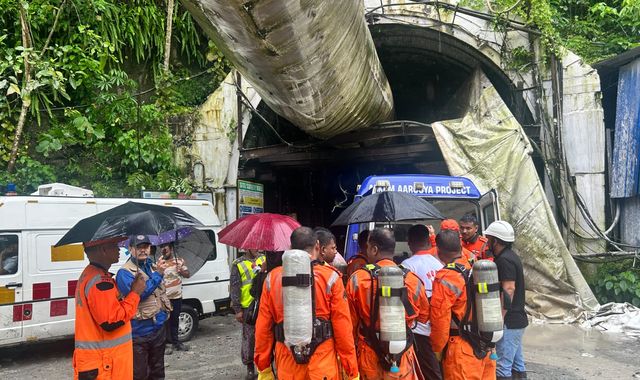
At least 10 people have died in a disaster inside an under-construction tunnel in India.
A suspected gas explosion at the tunnel, at a hydroelectric project in India's northeastern state of Sikkim, near the border with China, has also left 17 missing. They are feared to be trapped.
It is understood the explosion triggered the collapse on Monday at Samardung village, around 25 miles from the state capital Gangtok.
A civil official, Anupama Tamling, told reporters in the area that multiple workers were carrying out construction work on the 500-megawatt Teesta hydroelectric project.
Survivors who managed to escape told authorities they heard a loud explosion before debris crashed through the tunnel, trapping dozens inside.
Six officials from the state-owned National Hydroelectric Power Corporation (NHPC) entered the tunnel to assist rescue efforts but became trapped themselves, officials said.
Local police chief Sonam Dolma told reporters: "We have recovered 10 bodies so far and 17 others are feared trapped."
Rescue teams, including the National Disaster Response Force (NDRF) have been struggling to reach those trapped due to hazardous conditions inside the tunnel, where toxic gases have accumulated.
NDRF official Nitin Kumar told reporters at the scene: "We found toxic gases such as methane, carbon monoxide and hydrogen sulphide inside the tunnel."
Construction accidents are not rare in India, where the country's rapid infrastructure growth often collides with fragile geology, construction lapses, extreme weather and safety standards.
Fragile mountains, seismic activity and unpredictable underground conditions in the Himalayan region make tunnel projects especially risky.
Read more on Sky News:
Family of six killed in Gaza in Israeli airstrike
Russian warship carries out weapons exercise off UK coast
In 2023, a section of a tunnel in northern Uttarakhand state collapsed, trapping 41 workers for 17 days before they were rescued.
Experts have warned the Teesta River, where the hydropower project is being built, lies in a seismically active region.
They add it is marked by young, fragile rock formations riddled with fractures and underground pockets that can trap ancient gases.
Dr Devesh Walia, a geology professor at North-Eastern Hill University in the neighbouring state of Meghalaya, said: "It is quite possible that methane along with other gases accumulated underground and may have triggered an explosion."

(c) Sky News 2026: At least 10 dead in India tunnel disaster with 17 feared trapped
 New defence secretary Wes Streeting hits out at Russia after live-fire exercise 40 miles off UK coast
 Woman seriously injured in suspected stabbing at church in County Waterford, Ireland
 Father, mother, their three daughters and son killed in Israeli airstrike in Gaza
 Parents urged to stop buying e-scooters as 'toys' as Ireland brings in new laws
 Why last two years are worrying for future of Arctic
 'Four precious miracles': Identical quadruplets born in Australia in a one in 15 million chance
 Rare Titanic letter written days before sinking to go on sale
 Anti-police protests erupt in Bologna after Moroccan man dies during arrest