


Donald Trump's claim that members of his administration are negotiating with Iran on the ongoing conflict has caused more confusion than clarity.
The US president has said multiple times that both sides have had "very good and productive" talks to end the war, which he claims his country has already won.
However, Iran has so far denied that any negotiations have taken place, with the spokesperson for the military mocking the Trump administration, saying in a televised address: "Have your internal conflicts reached the point where you are negotiating with yourselves?"
Iran war latest: Follow live
With barrages of attacks still being launched across the Middle East from Iran, Israel and the US, what exactly do we know about potential negotiation talks and what each side wants?
What has Trump said?
The US president said in a post on Truth Social on 24 March that the two countries had been in "very good and productive conversations" for multiple days.
The declaration of progress came just as a deadline he gave to Iran to release its grip on the Strait of Hormuz - or he would "obliterate Iran's power plants" - was about to come to an end.
As a result, he instructed the US military to postpone "all military strikes against Iranian power plants and energy infrastructure".
When quizzed about the talks a day later, Mr Trump said his son-in-law Jared Kushner, his special envoy Steve Witkoff, vice president JD Vance and US secretary of state Marco Rubio were the team involved in the negotiations, as well as himself.
Despite the president's bold claims on negotiations - and that Tehran had "agreed they'll never have a nuclear weapon" - sources have told Sky News more than 1,000 extra US soldiers are being deployed to the region.
The president approved the deployment on Monday night, and the orders were being written on Tuesday for the headquarters, staff, and some ground forces, with the additional forces potentially being sent in the coming days.
Who is representing Iran?
Mr Trump has said the country is talking to the "right people" to make a deal, but it remains unknown who exactly those people are.
Iran's new supreme leader, Ayatollah Mojtaba Khamenei, hasn't been seen or directly heard from since he was named to replace his father, Ali Khamenei, who was killed by the US and Israel during the first days of the conflict.
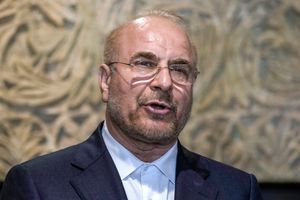
Other potential figures within the Islamic Republic include Iranian parliament speaker Mohammad Bagher Ghalibaf, foreign minister Abbas Araghchi and President Masoud Pezeshkian.
The spokesman of Iran's top military command, major general Ali Abdollahi Aliabadi, vowed that the fighting "will continue until complete victory" a potential defiance to Mr Trump's claims or a warning to anyone within the Iranian leadership not to back down in talks.
Who is Mohammad Bagher Ghalibaf?
Are talks actually happening?
Military analyst Professor Michael Clarke believes that talks are indeed going on, but they are very indirect.
He said it appears that Pakistan's army chief, general Asim Munir, has mediated over a process similar to "Chinese whispers".
Professor Clarke said it appears Mr Munir, is speaking directly to Iran's parliamentary speaker Mr Ghalibaf, who he described as the "last man standing" influencing the Iranian Revolutionary Guard.
He added that Pakistan's prime minister, Shehbaz Sharif has also spoken to Iranian President Mr Pezeshkian.
The information from both those talks has then been relayed to Mr Witkoff and Mr Kushner, Mr Trump's key diplomatic envoys, who then informed the president.
What does each side want?
Since the start of the war in February, Mr Trump has given vague and often shifting objectives for what he wants to achieve.
Across the nearly month-long conflict, he has insisted on the surrender of Iran's leaders and the removal of all the country's enriched uranium, which is critical to its disputed nuclear programme.
Iran has refused that demand in the past, insisting it has the right to enrich uranium for peaceful purposes.
The announcement of negotiations may be interpreted as a signal that Mr Trump is wary of the war's possible long-term damage to the US and global economies. Mr Trump has repeatedly demanded the Strait of Hormuz be kept open.
The Iranian regime has reiterated that the key shipping lane remains open and only vessels "belonging to or associated with the aggressors and those participating in their acts of aggression", namely Israel and the US have restricted access.
? Follow Trump100 on your podcast app ?
Professor Clarke added that by Mr Trump postponing strikes on key Iranian infrastructure, Iran believes it now has the upper hand, and has started to "lay out their terms for peace".
But he added there is "zero chance" their terms would be accepted, which include not giving up ballistic missile capabilities and nuclear capabilities.
The 15-point vs 5-point plan
Similar to the war in Ukraine and Gaza, Mr Trump has said the US has put together a 15-point plan for the end of the conflict in Iran.
The plan has been delivered to Iran by intermediaries from Pakistan, who have offered to host renewed negotiations, according to the Associated Press.
While Mr Trump hasn't given any details of the plan, beyond claiming it involves Iran's nuclear programme, Israel's Channel 12 reported it has gathered some of the content, citing a "Western source".
Some of the reported points include:
Iran has called Mr Trump's proposal "excessive" adding that Iran will "end the war at a time of its own choosing".
An official was cited by Iranian state TV as saying that Tehran told the US via an intermediary that it will continue defending itself, setting out five conditions under which Iran would end the war:
- A halt to the "aggression and assassinations";
- Concrete mechanisms to ensure that Iran will not be attacked again;
- Payment of war damages and reparations;
- An end to the war across all fronts and for all resistance groups involved throughout the region;
- International recognition and guarantees regarding Iran's authority over the Strait of Hormuz.
What is Pakistan's role?
Pakistan has offered to host renewed negotiations between Washington and Tehran, according to the Associated Press.
In a post on social media, Prime Minister Mr Sharif said: "Subject to concurrence by the US and Iran, Pakistan stands ready and honoured to be the host to facilitate meaningful and conclusive talks for a comprehensive settlement of the ongoing conflict."
He tagged the accounts of Mr Trump, Mr Witkoff and Iran's foreign minister Mr Araghchi in the post.
According to three officials from Pakistan, Egypt and the Gulf, the US has agreed "in principle" to join talks in the country, while mediators were still working to convince Iran.
Efforts are centred on "trust-building" between the two countries with the aim of reaching a pause in fighting and a "mechanism" to reopen the Strait of Hormuz, the officials said.
Is Israel involved?
Notably, Israel is not involved in the move for negotiations.
Israel has previously depicted itself as following Mr Trump's lead on the conflict but it has still pursued its own war aims beyond those of the US.
Read more from Sky News:
Who is behind mystery oil bet?
Why are zombie ships suddenly appearing in the Strait of Hormuz?
In a statement on Monday Israeli Prime Minister Benjamin Netanyahu acknowledged Mr Trump's diplomatic efforts but said Israel would continue to strike its enemies for the time being.
An end to the war in Iran would also not guarantee an end to Israel's campaign in Lebanon. There, Israel has seized a new opportunity to try to crush Hezbollah after the militants fired rockets in support of Iran.

(c) Sky News 2026: Are US-Iran peace talks actually happening? Everything we know so far
 Instagram and Facebook owner Meta ordered to pay £280m for knowingly harming children
 Palestinian teenager was starved in prison before death, judge rules
 Skeleton of Three Musketeers' d'Artagnan may have been found under Dutch church
 Floods in Kenya leave 88 dead and thousands displaced
 Denmark election: PM Frederiksen faces fight to stay in post after losses
 The Iranian former commander who could be Trump's pick to negotiate with
 Wildlife Photographer of the Year: People's Choice winner named
 Italian politician resigns over stake in mafia-linked restaurant as Giorgia Meloni suffers first defeat