

A month into the Iran war and the prime minister, on a visit to Finland with allies in the Joint Expeditionary Forces military coalition this week, left me in no doubt that he believes our lives, our country and the way we do things, is about to profoundly change.
This is a "once in a generation moment" that is going to shape the next decades of our lives, Keir Starmer told me as part of a longer-than-normal interview for our Electoral Dysfunction podcast, as he reflected on the global turbulence and how the outlook for Britain's economy had changed so massively in such a short period of time.
? Click here to listen to Electoral Dysfunction on your podcast app ?
We also touched on the turbulent times he has faced in recent weeks, be that around the prospect of a leadership challenge or the Peter Mandelson crisis that he told me he "beats himself up about it" in a genuinely emotional moment of our conversation.
What I took from this interview is a prime minister rolling the pitch for another difficult stretch for a country already ground down by crises with very long tales: the 2008 financial crash that ushered in austerity and a step down in living standards; the COVID-19 pandemic that saw the government borrow over £300bn in 2021/2 and leaving the Treasury to spend £100bn a year on debt interest alone.
"I think in my life, I remember profoundly the Berlin Wall coming down. And I remember that feeling, that there was going to be peace and freedom and that the values that I held dear… and that I didn't think - I have to say - I would ever see Russian tanks going across a European border again in my lifetime. I didn't think I would see that. And yet we saw that four years ago," he said.
"In the Middle East, Iran is a threat to all of its neighbours, a threat to the world and therefore, how this ends will determine what that threat is as we go forward. So this is a defining period. It's a testing period for the whole world."
There are political parallels too, with say 2008. Back then the prime minister Gordon Brown was grappling with a financial crisis and a potential leadership challenge as MPs looked down the barrel of defeat at the next general election.
At the time, Mr Brown warned his would-be challenger David Miliband, and his restive party, that "now is not a time for a novice". Does Keir Starmer feel the same?
"That's not for me to say, in the sense of whether it's the right time for a novice, I'll be judged by what I do," he said.
What he is more forthright on is that this crisis, this war on two fronts, will bring serious consequences for the UK. He acknowledged in our interview that the spring statement, in which the chancellor spoke about stability, failing inflation and interest rates, seems now like a fever dream. That the outlook for the economy has been so battered by Trump's war is, of course, a frustration.
But the prime minister is pragmatic about the place he's in: "There's no point me sort of complaining about it. That's the world we live in. You've got to face the world as it is. I have to lead us through this war too on two fronts."
Read more:
McSweeney phone theft linked to Mandelson files 'far-fetched'
Trump says he's disappointed in Starmer
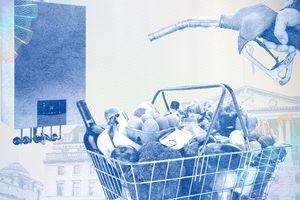
His immediate task as prime minister is to decide on support for energy bills. The current price cap runs out in June, after which bills could rise by an eye-watering £500 a year, according to the Resolution Foundation.
The prime minister told me in our interview that "any support is likely to be targeted". This will come with controversy.
Liz Truss’s administration poured £40bn into capping energy prices for all households at the start of the Ukraine war in 2022, and one in two people think the government can afford to subsidise bills, according to a recent YouGov poll.
But this prime minister is clear he won't do that. "We will have to tailor support. Exactly how we do that is obviously a number of options we're looking at. But I'll be clear with you, it will be tailored," he said.
With the Organisation for Economic Co-operation and Development (OECD) on Thursday saying the UK will be the worse hit from the Iran war, predicting a 0.5 per cent contraction in GDP, it is an awful position for the prime minister to be in. But he seems up for the fight.
When I asked him about Trump's treatment of him, he simply said that Trump might apply pressure, but he is "not going to back down" or "buckle under pressure", and when it comes to this predicament at home and the upcoming May elections, there is no way he is going to stand down.
When I asked him about Angela Rayner and Andy Burnham semi-declaring on a leadership race, he doesn’t bristle, he simply says he expects to see Angela "playing a leading role in this Labour government".
It is when we come to Mandelson that some of the pressure of the past few weeks and months perhaps comes more to bear.
I genuinely can not understand, looking at the vetting document, how the prime minister got to the place of appointing Mandelson, when it was clear he kept a relationship with Epstein post conviction of prostitution of a minor and was sacked twice by previous Labour governments.
When I asked him if he was angry at himself, he told me that "nobody has been harder on me in relation to the mistake I made".
"I hate the fact I made that mistake, I dwell on it. I beat myself up about it. It’s certainly not a mistake I’d ever repeat."
But as for being beaten by it, Starmer is doing the opposite, he is digging in. He promised the country this would be the year he would cut the cost of living, but the war in Iran looks almost certain to derail that, unless resolution is swift.
Despite the growing complications and challenges, he seems to believe he is the leader for the moment - despite what Trump, his critics, and even some in his cabinet might say.
Trump says Starmer is no Churchill, but these wars, if they become more prolonged, will put him in the unenviable position of being a wartime prime minister.
He tells me he has "great determination" to "steer our country through this" even as the outlook worsens for the economy. In the coming weeks, the consequences of that will be laid bare. Starmer, despite the ferocious criticism he’s faced, clearly thinks he is the right man for this moment.
He told me that his prime minister's advice to his younger self would be to rise to the challenge and accept the bumpy road - and he's betting that the worse this crisis gets, the more his party will agree with him.
He is applying the rule of "never waste a crisis", but where this war, our economy and our prime minister lands is anyone's guess right now.
You can catch the full interview on the podcast, which is available now. Listen wherever you get your podcasts, just search for Electoral Dysfunction and hit follow.
You can also watch the full interview on Sky News's YouTube channel.

(c) Sky News 2026: Starmer thinks he is the right man for this moment - despite what Trump says
 Hundreds of teenagers to be banned from using social media for trial period
 Greens pile pressure on Ed Miliband to end 'rigged energy system'
 Afghan asylum seeker jailed for abducting and raping 12-year-old
 Seedance 2.0: Could this uncannily good AI make blockbuster films that are worth watching?
 Meta and YouTube found liable in landmark social media trial
 UK facing biggest economic hit from Iran war of any major country
 Morgan McSweeney phone theft conspiracy theories - it's the job of journalists to seek the truth
 Three areas industry is warning government about due to Iran war