


Sperm whales can hang vertically in the water while sleeping by releasing gas bubbles that regulate their buoyancy, scientists found.
The behaviour was first documented by naturalists in 2008, with the species being the only type of whale known to rest in a heads-up vertical position.
Scientists believe by maintaining the position just below sea level sperm whales avoid being buffered by the waves, which helps them to sleep better, rather than expending the energy to dive deeper into the ocean.
Until now it has been unclear how the whales maintain their position just below the surface while apparently asleep.
In a new study, scientists at the University of St Andrews and Universite de Neuchatel in France have discovered they do so by releasing gas bubbles to maintain their neutral buoyancy.
Professor Patrick Miller, from the Sea Mammal Research Unit at the University of St Andrews, said the whales initially dive head-first but they "slowly rotate to be head up".
This is due to the spermaceti oil in their heads, which is much lighter than the rest of their bodies.
"By releasing air, that's going to decrease the positive buoyancy of the animal, which will slow it from going up towards the surface," Professor Miller said.
He added: "Then, initially, the animals are still slowly moving up towards the surface once they spin to this vertical position.
"And the way that they combat that is by blowing bubbles. So, each time they release a bubble, the analysis was able to show how that slowed the ascent towards the surface, helping the animal stay just beneath the surface."
Since they must come to the surface to breathe, each "resting dive" lasts 20 minutes or so, with the animals typically completing several resting dives in succession.
The team of scientists collected data by placing small tags using suction cups on sperm whales off the Norwegian coast.
The tags, which record sound and 3D animal movements, captured clear bubble sounds, while animal movement data was used to create a simulation taking in tissue density, drag through the water and gas volumes in the animals' bodies.
The simulation confirmed that the release of bubbles reduced the whales' positive buoyancy, enabling them to remain submerged while resting.
Professor Miller said the gases likely accumulate in the whales' bodies when they deep dive in search of prey, spending as long as an hour at depths of as much as 2,000m beneath the surface.
"They're literally holding their breath the entire dive," he said.
"Some of the gasses that will be produced during the dive will be carbon dioxide, which releases quite slowly from the body, and nitrogen, which is known to build up under pressure."
Read more from Sky News:
UK's first sight-saving gene therapy
Greenland's impact on UK weather
The team said long foraging dives, or a series of such dives, can result in a "gas exchange deficit" in the whales' bodies, and that "off-gassing" while in their resting state could also serve as a way of balancing this out.
It is not known whether the whale needs to be awake in any way to regulate their buoyancy.
Professor Miller said further studies of the whales' brain waves - or even their "eye state" while in their resting state - was needed to answer this question.
"To really understand these animals, we need to understand their environment and the challenges they face in that environment, which can be very different from the kinds of things that we terrestrial mammals face," he said.
"We sometimes give sperm whales sort of human characteristics - how smart they are, their sociality.
"However, I think it's also really important to look at the ways that they're different from us and the very different ways that they've had to adapt to live in the sea as they do."

(c) Sky News 2026: Sperm whales release bubbles to regulate buoyancy and sleep floating vertically, scientist
 OpenAI admits its models hacked another company in 'unprecedented cyber incident'
 Anthony Joshua wins comeback bout against Kristian Prenga in second-round knockout
 India's 'Cockroach' movement to end protests after education minister quits
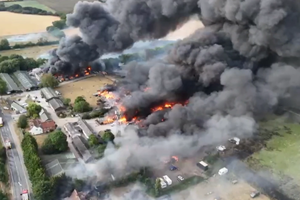 Firefighters injured and fire engines destroyed after industrial site blaze in Essex
 US imposes new tariffs on dozens of trade partners over 'forced labour' imports
 What Burnham means for your money - from income tax to pensions
 Knife came 'a millimetre from my brain': Salman Rushdie testifies at attacker's terrorism trial
 Burnham should 'build bridges' with sacked Starmerites like Darren Jones, says Harman