


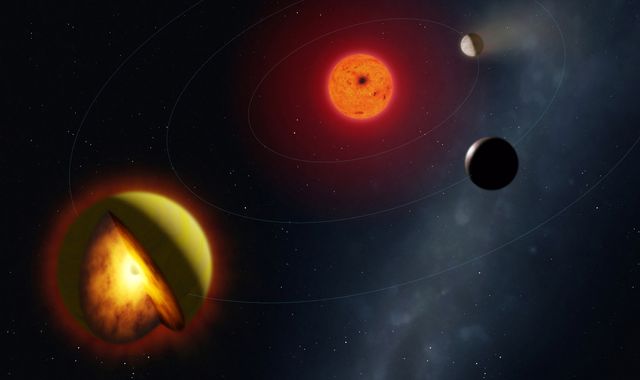
Astronomers have spotted a molten alien planet orbiting a star in our neighbourhood of the Milky Way galaxy that has a surface not unlike a vision of hell.
The planet, named L 98-59 d, is covered with magma and has a noxious and fiercely hot sulfur-rich atmosphere.
It has a diameter more than 60% greater than that of the Earth, though its density is only about 40% in comparison.
The planet orbits a star dimmer and slighter than the sun located around 34 light-years from Earth in the constellation Volans.
A light-year is the distance light travels in a year, 5.9 trillion miles (9.5 trillion km).
"The planet lacks distinct structure within its magma ocean, so there is no crust, upper mantle and lower mantle. The magma ocean is a single deep, mushy layer," said Harrison Nicholls, a postdoctoral researcher at the University of Cambridge Institute of Astronomy.
Mr Nicholls is the lead author of the research published on Monday in the journal Nature Astronomy.
Small crystals of solid rock may be trapped within the turbulent fluid magma that makes up the mantle, Mr Nicholls added.
The planet's metallic core appears to be relatively small, with the magma ocean comprising 70-90% of the planetary interior radius - reaching a depth of between 2,775 and 3,565 miles (4,465-5,740 km).
Its thick atmosphere is primarily made up of hydrogen, but has a very high sulfur content.
Around 10% of the atmosphere is the toxic gas hydrogen sulfide, giving off the odour of rotten eggs.
The atmosphere has created a runaway greenhouse effect, trapping heat from the star, that keeps the planet's surface hot enough to remain molten.
"Your nose can smell hydrogen sulfide at concentrations of something like one part per billion, so this would be overwhelmingly stinky. But you wouldn't survive long enough in this hot atmosphere to notice," said planetary scientist and study co-author Raymond Pierrehumbert of the University of Oxford and Massachusetts Institute of Technology.
The atmosphere's composition suggests a high sulfur content in the planetary interior, according to the researchers.
Read more from Sky News:
Three arrested after man's body found in wheelie bin
Dubai airport shutdown affects thousands of UK passengers
The planet was discovered in 2019, then was observed by the James Webb Space Telescope in 2024, and by ground-based telescopes in 2025.
The researchers used advanced computer simulations to reconstruct its history, spanning nearly five billion years, making it somewhat older than Earth, which is estimated to be 4.54 billion years old.
The planet orbits a common form of star called a red dwarf.
The star's mass is just under 30% that of the sun, and its luminosity around 1% that of the sun.
L 98-59 d is the third of five planets known to orbit this star.
More than 6,100 planets beyond our solar system, called exoplanets, have been discovered since the 1990s.
But this planet's unique combination of a magma ocean, and a sulfur-laden atmosphere, puts it in a class by itself - for now.
"This planet's surface is in excess of 1,500 degrees Celsius (2,732 degrees Fahrenheit), so it would not harbour life as we know it," Mr Nicholls added.

(c) Sky News 2026: 'Stinky' molten planet spotted by astronomers with surface not unlike vision of hell
 Survivor of online child abuse shares story as 'deeply shocking' rise in crimes revealed
 Kent meningitis outbreak a cruel reminder young people are most at risk
 Meningitis: The symptoms, treatments and how to find out if you need the vaccine
 Environment Agency enforcement officers could be given 'police-style' powers to tackle waste crime