


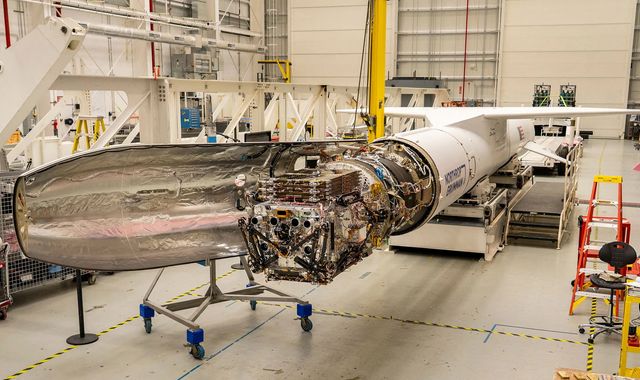
A spacecraft has blasted into orbit on a mission to rescue a NASA telescope that is at risk of crashing back to Earth.
The three-armed Link spacecraft was launched on Friday aboard a Pegasus rocket released from a modified aircraft over the Pacific Ocean.
Operated by Katalyst Space Technologies, the spacecraft is expected to reach NASA's Swift observatory in around a month's time before capturing the ageing telescope and lifting it into a higher orbit.
Swift, which was launched in 2004 to study some of the universe's most powerful explosions, has been descending more quickly than expected because increased solar activity has expanded Earth's upper atmosphere, creating greater drag.
NASA is paying Katalyst $30m (£22m) to carry out the rescue mission in the hope of extending the telescope's working life.
If successful, Link will gradually raise Swift's orbit by around 150 miles, returning it to the altitude at which it first began operating.
Scientists hope the observatory will resume scanning the skies for gamma-ray bursts and exploding stars by September.
Read more from Sky News:
Venezuela's interim president defends earthquake response
Iran preparing for funeral of supreme leader
Observations have been paused while the rescue mission takes place in an effort to preserve as much of the telescope's remaining orbit as possible.
Without intervention, NASA said Swift would have re-entered Earth's atmosphere and burned up as early as October.
Katalyst Space Technologies developed the mission in just nine months after NASA warned there was only a narrow window to save the observatory.
"This is a high-risk, high-reward mission," Katalyst chief executive Ghonhee Lee said before launch.
"The biggest danger was always we don't launch anything and we let Swift burn up in the atmosphere. So we were always trying to avoid that risk."
A similar mission could one day be used to extend the life of the Hubble Space Telescope, which is also gradually losing altitude because of increased atmospheric drag linked to heightened solar activity.

(c) Sky News 2026: Spacecraft launches to rescue NASA telescope before it crashes back to Earth
 Google must pay record €4.1bn fine over antitrust issues
 Public warned to avoid polluted burn water at Scottish beach
 So how much did Trump make from crypto last year?
 Voice of Gene Wilder recreated by AI for new Wonka-themed Netflix series