

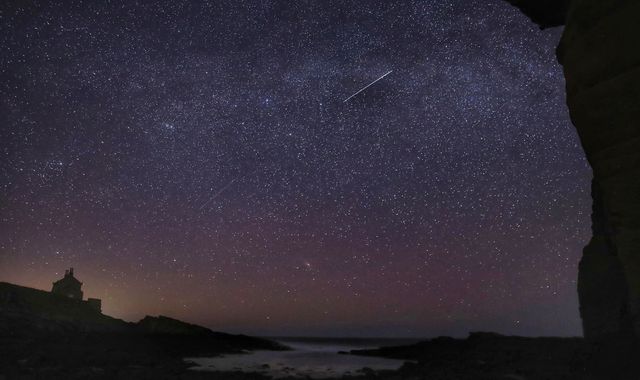
Stargazers across the UK could spot a burst of meteor activity over the next few nights, showcasing up to 18 fast and bright space rocks an hour at its peak.
The Lyrid meteor shower, which comes annually in April, is the oldest known to man, first spotted in 687 BC by Chinese stargazers.
It will reach maximum tonight, two days before the first quarter moon, meaning the lunar glow will not cause too much light pollution, according to the Royal Observatory in Greenwich.
But you also stand a chance of seeing it up to Saturday.
Here's everything you need to know.
How to watch the Lyrid meteor shower
You have the best chance of spotting the shower tonight, as it is at its peak.
The further away we get from the maximum, the harder it becomes to see the shower.
You can start looking once it's dark, but you'll be giving yourself the best chance of seeing the meteors after the moon has set, from 2am onwards, says the Observatory.
It says this is because the Earth will have spun towards the cloud of debris at this point, making it easier to spot the meteors.
Try to move away from lights to reduce light pollution and look towards the darkest parts of the sky once the sun has set this evening.
NASA recommends letting your eyes adjust to the dark for around 30 minutes. After that, you should be able to see the meteors.
What about the weather?
The good news is forecasts show that the vast majority of the UK will be dry overnight for the next few evenings.
Sky News' weather producer Jo Robinson says: "Thankfully, high pressure is in change this week, bringing largely clear skies at night.
"That said, there will be some low cloud or fog around at times, with northern, central and eastern parts most at risk.
"The clear skies do mean that it will be quite chilly for anyone heading out to see the meteor shower, with a frost in some rural spots."
You might be hanging around for a while, so it's worth wrapping up warm and grabbing a blanket to lie back on - or a deck chair, if you want a comfier experience.
"Be patient," NASA says. "The show will last until dawn, so you have plenty of time to catch a glimpse."
What causes the Lyrid meteor shower
The Lyrids come from the constellation of Lyra. Their actual origin is the Comet Thatcher, which is not named after the former prime minister but the amateur astronomer Alfred Thatcher, who discovered it in 1861.
Read more:
'God of chaos' asteroid Apophis set to pass close to Earth
Why your hay fever is getting worse
Meteor showers, or shooting stars, are caused when pieces of debris, known as meteorites, enter Earth's atmosphere at speeds of around 43 miles per second, burning up and causing streaks of light.
These chunks are moving very quickly compared to our atmosphere so the air around them heats up.
This makes the meteor heat up too and glow brightly, which is what we see.
The surface of these meteors can reach up to 1,600 degrees celsius.

(c) Sky News 2026: Lyrid meteor shower: How to spot the celestial show - and what will the weather be like?
 Sexual predators' new business model is spreading - and humans are needed to catch them
 The robot that can outplay elite table tennis players
 Parents hail 'incredible' results after six-year-old girl has sight restored by gene therapy
 Mars rover discovers organic molecules - hinting at possibility of ancient life