


Fresh conflict in the Middle East threatens to make the cost of petrol more expensive for motorists in the UK, experts have warned.
Escalating oil prices could see higher costs for consumers across the British economy - and the first place those rises will show up is at the fuel pumps.
Will the cost of petrol go up?
Fuel retailers base the cost of petrol and diesel on a number of factors, but the money paid out by motorists at the forecourts is strongly impacted by wholesale crude oil prices.
On Friday, the oil price was below $70 (£52) a barrel, but on Monday - after the US-Israel strikes on Iran - this had gone up to $78 (£58) a barrel.
Many economists believe this could reach $100 (£74) a barrel if the situation in the Middle East goes on for too long.
How quickly could prices rise?
Oil prices have gone up by around 9% since Sunday night - with more rises potentially on the horizon amid the volatile situation.
Increases in crude oil prices normally take two weeks to filter through to the fuel pumps, according to motoring organisation, the RAC.
Another thing that impacts pump costs is the exchange rate because oil is priced in US dollars, the RAC says.
This means a stronger British pound against the US dollar makes UK prices less expensive.
Read more:
Markets latest - big spike in oil prices
Which Iranian officials have been killed?
How does the conflict impact prices?
The Middle East is the most important oil-producing region in the world.
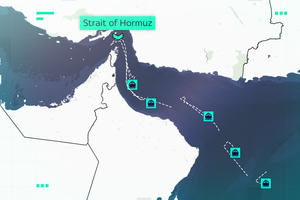
The Strait of Hormuz on Iran's southern border is a crucial trading route which allows the movement of a fifth of the world's oil trade - or 21 million barrels a day.
The 100-mile waterway leads from the Persian Gulf into the Gulf of Oman and to the Arabian Sea and the Indian Ocean.
There are fears that if the waterway were blocked, it could cause a significant rise in oil prices.
What do experts think could happen to prices?
Jorge Leon, of energy intelligence firm Rystad Energy, said any blockage of the Strait of Hormuz would directly impact British motorists.
He said: "We have a direct effect - which is higher prices at the pump and higher electricity bills, but also a secondary effect, which is things will get more expensive because inflation might increase."
However, some experts believe the movement of oil and trade would adjust to any continuing conflict.
John Stawpert, of the International Chamber of Shipping, the global trade association for ship owners and operators, said "shipping is very well placed to adapt in the face of a crisis".
He added: "It's important to stress that, whilst this is a big shock, and we are very concerned about reported attacks against shipping in the region, trade is continuing to flow, the straits are not closed, so any impact that we would see is likely to be minimal unless there is a big change in the security dynamic in that region."

(c) Sky News 2026: Will the cost of petrol in my car go up because of Middle East conflict?
 Mark Kleinman blog | US bidder Tilray Brands snaps up BrewDog in bargain £40m swoop
 Oil prices spike as key shipping route disrupted by Iran attacks
 Ship tracking reveals tankers and millions of barrels of oil stuck in the Gulf
 Marine biologist on salaries, tears and the one thing everyone could do to save the planet
 Flight delayed or cancelled? These are your rights to care and compensation
 Paramount strikes deal to buy Warner Bros Discovery for $110bn
 Thinking of paying off student loan early? You should know about expert's £60,000 rule | Money newsletter
 Trump's furious response to Anthropic is as much about power as it is about AI safety